Professional drone photography, inspection, mapping and filming for listed buildings, churches, abbeys, minsters, cathedrals and heritage properties throughout Yorkshire and the UK.
Historic buildings often contain some of the most difficult areas to inspect, record and maintain. High roofs, towers, spires, chimneys, parapets, stonework and complex architectural details can be expensive or disruptive to access using conventional methods.
Sky Filming uses professional drones and high-resolution cameras to provide detailed aerial imagery of historic and heritage buildings, helping architects, building surveyors, conservation specialists, contractors, property managers, churches and building owners see areas that may otherwise be difficult to examine.
We can also document conservation and restoration projects over time, create aerial maps and 3D models, or produce professional promotional films that show historic buildings and their surroundings from a completely different perspective.
Sky Filming has operated professionally since 2010 and is based in York, a city surrounded by historic architecture and heritage sites.
Our heritage building services include:
- High-resolution roof and structure photography
- Church and ecclesiastical building inspections
- Tower, spire and chimney photography
- Stonework and façade inspection
- Gutter, flashing and leadwork photography
- Listed building surveys
- Conservation and restoration documentation
- Before-and-after restoration photography
- Repeat progress monitoring
- Photogrammetry and 3D models
- Detailed aerial maps
- Promotional aerial filming
- Ground photography and video
- Historic estates and visitor attractions
- Television and documentary filming
If you need to inspect, document or film a historic building, send us the location and an outline of what you need to see. We can assess the site and recommend the most appropriate approach.
Drone Surveys for Historic and Listed Buildings
Historic buildings often have complicated roofs and elevations containing features that cannot easily be seen from ground level.
A drone can quickly obtain high-resolution photographs and video from above, alongside and around the building without requiring people to access the structure simply to obtain an initial visual record.
Suitable buildings include:
- Grade I, Grade II* and Grade II listed buildings
- Churches
- Abbeys
- Minsters
- Cathedrals
- Chapels
- Historic halls
- Manor houses
- Country houses
- Castles and fortifications
- Former mills and industrial heritage buildings
- Historic schools and colleges
- Museums
- Civic buildings
- Monuments and memorial structures
- Historic hotels and visitor attractions
- Large private estates
Every building is different. Before flying, we assess the architecture, surrounding environment, public access, airspace and practical requirements of the project.
Church, Abbey, Minster and Cathedral Drone Inspections
Churches and other ecclesiastical buildings are particularly well suited to drone photography because many of their most important structural features are difficult to inspect from the ground.
Towers, spires, high pitched roofs, parapets, gutters and ornate stonework can be tens of metres above ground level.
A drone can provide detailed visual access to areas such as:
- Roof coverings
- Ridge tiles
- Lead roofs
- Flashing
- Valleys
- Gutters and downpipes
- Parapets
- Towers
- Spires
- Pinnacles
- Finials
- Chimneys
- Bell towers
- Stonework
- Pointing
- Decorative masonry
- Window surrounds
- Roof junctions
- Storm damage
- Vegetation growth
- Areas of suspected water ingress
We can work directly with the building’s architect, surveyor, conservation specialist, roofing contractor or stonemason.
Where useful, the specialist can be present during the flight and direct us towards particular areas that require closer examination.
Alternatively, we can work from photographs, drawings or a written brief supplied beforehand.
Detailed High-Resolution Inspection Photography
For inspection projects, the objective is normally very different from conventional aerial photography.
Rather than simply producing attractive photographs of the building, we systematically capture the architectural details that the client needs to examine.
This can include photographing the same feature from several directions and heights so that the surveyor has enough visual information to understand its condition.
Depending on the building, we may provide:
- Wide photographs establishing the position of each area
- Medium-distance photographs showing groups of features
- Detailed close views of specific defects
- High-resolution video passes
- Vertical roof photographs
- Oblique roof photographs
- Elevation photography
- Overview photographs of the entire property
The original high-resolution files can be supplied so that architects and surveyors can enlarge areas on a computer and examine details more closely.
We Provide the Imagery — Your Specialist Provides the Diagnosis
Sky Filming provides aerial access, photography, video and other visual data.
We do not pretend that a drone pilot replaces a conservation architect, structural engineer, building surveyor, roofer or stonemason.
Where a technical building-condition assessment is required, the imagery is supplied to the appropriately qualified professional for interpretation.
This arrangement can be particularly useful because the specialist can concentrate on the building itself while we deal with the aircraft, flight planning, camera operation and aerial access.
It can also allow an initial visual investigation to be carried out before deciding whether scaffolding, rope access or other physical access is required.
Historic Roof Inspections
The roofs of historic buildings can be particularly complex.
A single property may contain several roof levels, pitched and flat sections, valleys, dormers, towers, chimney stacks, parapets and areas that are almost impossible to see from ground level.
Drone photography can be used to investigate:
- Missing or slipped tiles
- Damaged slates
- Leadwork
- Flashing
- Valleys
- Blocked gutters
- Damaged gutters
- Roof junctions
- Chimney stacks
- Parapets
- Water ingress routes
- Storm damage
- Previous repairs
- Vegetation and debris
For large or complicated roofs, we can also create an overall aerial map or 3D model to help relate individual detailed photographs to their location on the building.
Towers, Spires and Chimneys
Tall structures are one of the clearest applications for drone inspection.
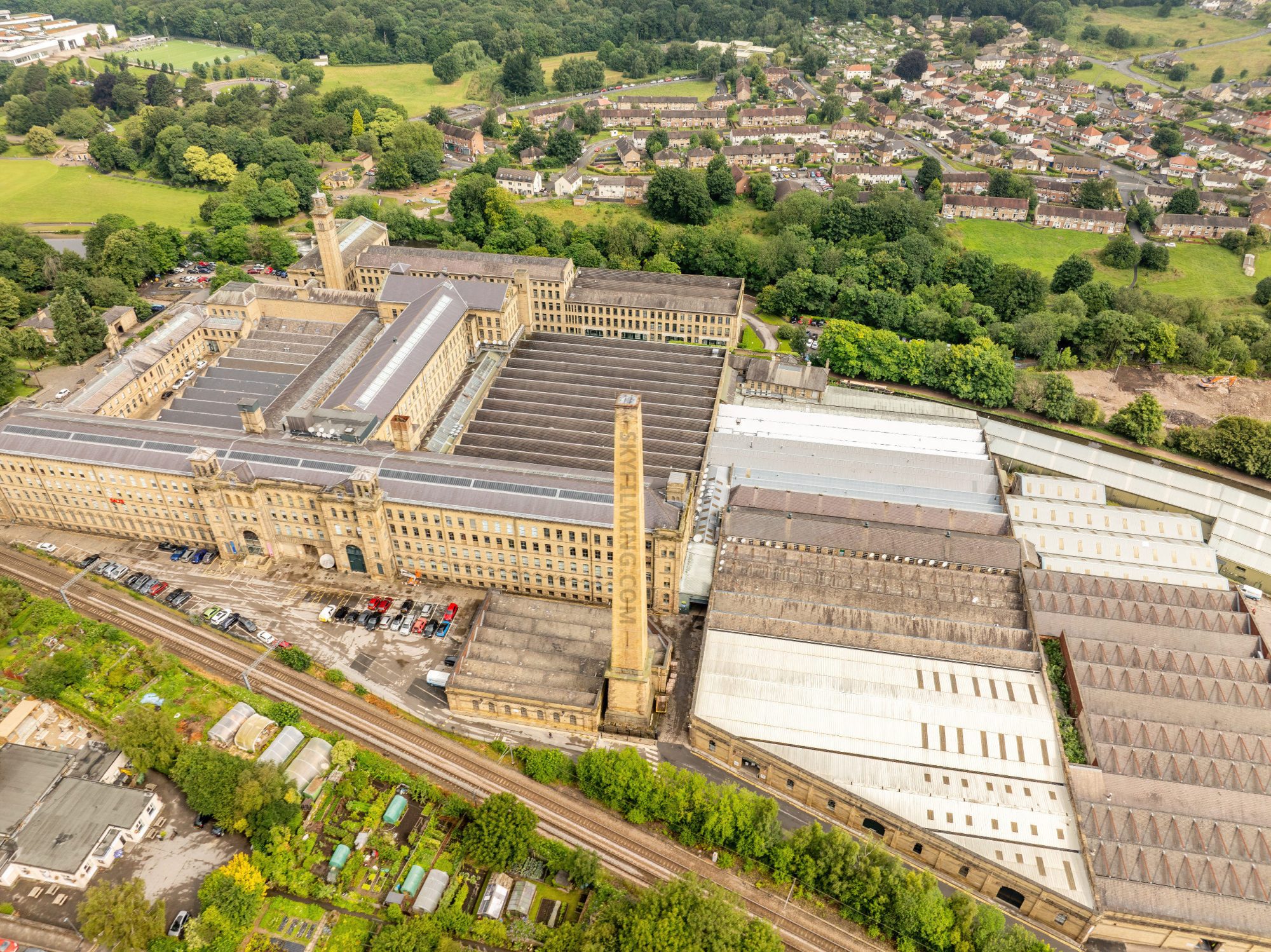
Sky Filming was commissioned to assist an engineer inspecting the approximately 70-metre-high historic chimney at Salts Mill in West Yorkshire.
We systematically photographed and filmed each face of the chimney from top to bottom, allowing the engineer to look for defects in the brickwork and examine previous pointing work near the top.
The chimney stands beside an active railway, so the operation also required additional consideration of the surrounding environment.
This type of systematic photography can be applied to:
- Church towers
- Spires
- Historic chimneys
- Clock towers
- Bell towers
- Monuments
- Pinnacles
- Turrets
- High masonry structures
[VIEW SALTS MILL HISTORIC CHIMNEY CASE STUDY]
Stonework, Masonry and Façade Photography
A large proportion of the fabric of historic buildings is vertical rather than horizontal.
Drones can obtain views of masonry and façades at heights and angles that are difficult to achieve from the ground.
Detailed photography can assist specialists examining:
- Cracked stone
- Weathering
- Failed pointing
- Loose masonry
- Discolouration
- Previous repairs
- Decorative stonework
- Cornices
- Parapets
- Window surrounds
- Buttresses
- Sculptural details
- Vegetation growth
- Water staining
Where appropriate, we can make controlled passes along an elevation to provide systematic coverage rather than isolated photographs.
Conservation and Restoration Projects
Drone photography is useful not only when something has gone wrong.
It can also create a detailed visual record before, during and after conservation work.
For restoration projects we can provide:
- Pre-work condition photography
- Construction and restoration progress photographs
- Repeat photography from consistent positions
- Detailed records of completed repairs
- Before-and-after comparisons
- Roof and elevation mapping
- 3D models
- Promotional photography
- Video documenting the restoration
- Material for reports and presentations
- Finished-project photography and filming
Regular photography can be particularly valuable on long projects because areas may become concealed or inaccessible as work progresses.
York Guildhall Restoration
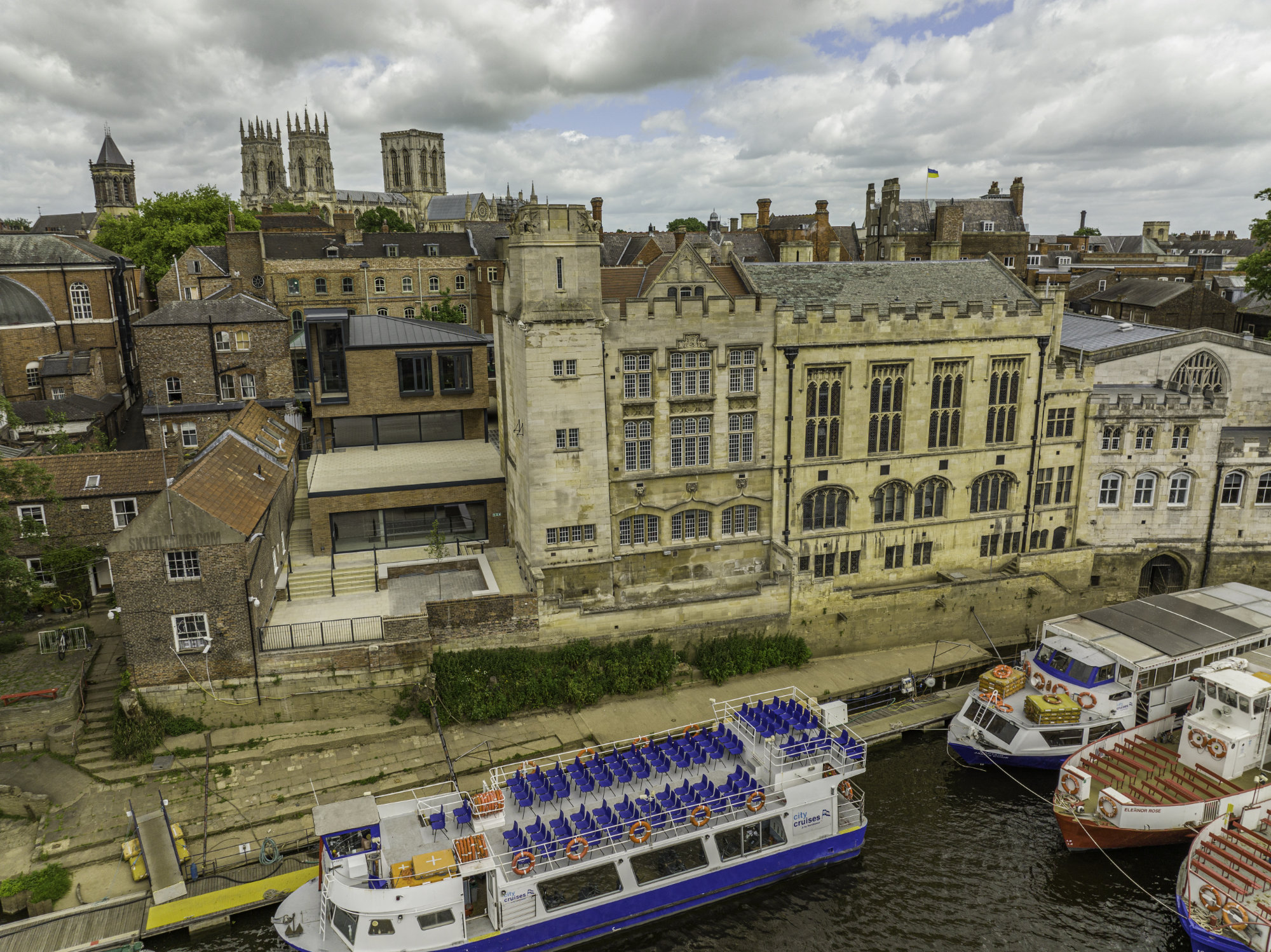
A good example of combining several drone techniques on one historic building was our work at York Guildhall.
Following major renovation work, Vinci Construction commissioned Sky Filming to capture high-resolution aerial photographs and video of the restored roof and associated new construction.
As well as conventional photographs and filming, we captured imagery to create an aerial map of the site and a computer model of the building.
This demonstrated how several types of aerial information can be gathered during a single visit: detailed inspection photography, overall documentation, mapping and material suitable for presentation and promotion.
Photogrammetry and 3D Models
A sequence of overlapping photographs can be processed using photogrammetry software to create a three-dimensional representation of a building or part of a building.
For suitable heritage projects this can provide a useful visual reference for:
- Understanding complicated architecture
- Recording the building at a particular point in time
- Planning restoration work
- Relating individual photographs to the overall structure
- Recording roofs and elevations
- Comparing future changes
- Presentations and stakeholder discussions
- Conservation documentation
A 3D visual model is different from a formal measured building survey unless the project has specifically been designed and controlled to provide that level of survey information.
We will discuss the required output before capture so that the appropriate method can be used.
Aerial Maps and Roof Plans
For larger buildings and complexes, individual photographs alone can make it difficult to understand where each detail sits within the wider structure.
We can capture overlapping vertical photography and create a high-resolution aerial overview of the roof and surrounding site.
This can be useful for:
- Large churches
- Abbey complexes
- Historic estates
- Schools and colleges
- Monastic buildings
- Museums
- Country houses
- Multi-building heritage sites
- Historic industrial complexes
The overall image can provide a useful visual reference alongside detailed inspection photography.
Monitoring Changes Over Time
Historic buildings require continuing maintenance.
Where a particular feature is causing concern, we can return at agreed intervals and attempt to reproduce similar photographs so that changes can be compared.
Repeat photography can help document:
- Progressive deterioration
- Movement or cracking
- Condition of previous repairs
- Roof condition
- Vegetation growth
- Weather damage
- Water-related problems
- Completed conservation work
The images provide a dated visual record that can be retained alongside other building-maintenance information.
Restoration Progress Photography
Major conservation projects can continue for months or years.
Regular aerial photography provides an effective way of recording the work as scaffolding moves, roofs are stripped and replaced, stonework is repaired and different parts of the building become accessible.
Visits can be arranged:
- Weekly
- Monthly
- At important project milestones
- Before scaffolding is erected
- While work is exposed
- Before scaffolding is removed
- On completion
We can combine drone photography with ground-level photographs, professional video and time-lapse cameras where a more complete project record is required.
Historic Building Promotional Filming
Not all heritage drone work is about defects and repairs.
Historic buildings are often visually spectacular, and aerial filming can show their architecture and relationship with the surrounding landscape in a way that conventional cameras cannot.
We provide heritage aerial filming for:
- Visitor attractions
- Historic estates
- Museums
- Tourism organisations
- Hotels and accommodation
- Film locations
- Educational organisations
- Heritage charities
- Restoration campaigns
- Websites
- Social media
- Television and documentary productions
- Fundraising videos
We can supply the original drone footage to your own production company or produce a complete finished video.
Listed Property and Historic Estate Filming
Sky Filming has filmed Grade II listed Langton Hall in North Yorkshire as part of a film production.
The work included aerial camera movements around the historic building and its surrounding landscape.
Large historic houses and estates can benefit particularly from aerial filming because the building is often only one part of the story.
A drone can also show:
- Gardens
- Parkland
- Woodland
- Rivers and lakes
- Courtyards
- Outbuildings
- Historic walls
- Approaches and drives
- Relationship with the surrounding landscape
This can be useful for tourism, hospitality, property promotion, television, documentary work and establishing a location for film production.
Filming Restoration Stories
Conservation projects often have a story worth telling.
A building may be undergoing a once-in-a-generation roof replacement, major stonework restoration or a programme intended to secure its future for another century.
We can document that process through a combination of:
- Drone filming
- Ground-based video
- Interviews
- Photography
- Time lapse
- Archive material supplied by the client
- Graphics and captions
The resulting film could be used for:
- Fundraising
- Grant reporting
- Visitor interpretation
- Social media
- Public engagement
- Project documentation
- Heritage presentations
- Donor communications
- Completed-project case studies
Drone Footage for Fundraising and Grant Applications
The scale of maintenance required on historic buildings can be difficult to communicate using written descriptions alone.
Clear aerial imagery can help demonstrate:
- The size and complexity of a roof
- Difficult access
- Areas of deterioration
- The scale of proposed restoration
- Work already completed
- The architectural importance of the structure
Photography and video can therefore be useful supporting material when explaining a project to trustees, donors, funding organisations or the wider public.
We can provide straightforward documentary imagery or create a more polished promotional video depending on the purpose.
Historic Industrial Buildings
Heritage does not only mean churches and country houses.
Britain contains thousands of historically significant mills, factories, warehouses, chimneys, railway structures and other buildings associated with its industrial history.
These can present particularly challenging inspection requirements because they are often extremely large and contain tall masonry, chimneys and inaccessible roof areas.
Our inspection of the historic chimney at Salts Mill is a good example of using modern drone technology to help with the ongoing care of an important industrial heritage structure.
We can provide similar visual inspection and documentation services for:
- Mills
- Historic factories
- Railway buildings
- Engine sheds
- Historic warehouses
- Industrial chimneys
- Water towers
- Bridges
- Former power and utility structures
Working Around Fragile and Important Buildings
Historic sites require a considered approach.
The building itself may be fragile, but there may also be visitors, residents, worshippers, contractors, neighbouring properties, roads or other restrictions around it.
Before operating we assess issues such as:
- Airspace
- Public access
- Surrounding buildings
- Roads
- Railways
- Trees
- Towers and architectural projections
- Scaffolding
- Cranes
- Construction activity
- Suitable take-off and landing areas
- Required flight distances
- Weather and wind around the building
- Site-specific restrictions
Where a building remains open to visitors or worshippers, flights can often be planned for a quieter period to minimise disruption.
Working With Architects, Surveyors and Conservation Professionals
We are happy to work as the specialist aerial element of a larger project.
The client does not need to understand drone technology or specify exactly how every photograph should be obtained.
Instead, tell us what information is required.
For example:
“We need to see the condition of the leadwork around the tower.”
“The architect needs detailed photographs of all four sides of the spire.”
“We need to identify which section of roof may be allowing water in.”
“We need photographs of the stonework before scaffolding is removed.”
“We want a complete record of the restoration.”
We can then work out how best to capture the required views.
If the specialist needs to direct the inspection live on site, we can work with them during the flight and obtain additional photographs as required.
Working With Churches and Heritage Organisations
You do not need to be a large construction company to commission professional drone work.
We can work directly with:
- Individual churches
- Parochial Church Councils
- Building trustees
- Heritage charities
- Historic property owners
- Estate managers
- Museums
- Visitor attractions
- Preservation groups
- Architects
- Surveyors
- Conservation contractors
- Roofing and masonry contractors
- Local authorities
- Educational establishments
If you are uncertain whether a drone would be useful, send us photographs of the building and explain the problem. We can advise whether aerial photography is likely to provide the information you need.
Why Use a Drone?
Traditional access methods remain essential when someone needs to physically touch, test or repair the building.
However, arranging scaffolding, a cherry picker or rope access simply to discover what is happening can be expensive and time consuming.
Drone photography can often provide an initial visual overview quickly and with minimal physical intervention.
Potential benefits include:
Visual access to difficult areas
High roofs, towers, chimneys and façades can be photographed from useful viewing angles.
Reduced working at height
A person does not necessarily need to access a dangerous location simply to obtain photographs.
Minimal contact with the structure
The drone does not need to touch the building.
Detailed permanent records
High-resolution images can be stored, enlarged, shared and compared in future.
Fast coverage of complicated buildings
Several roof levels and elevations can often be documented during one visit.
Useful information before access work begins
The imagery can help architects and contractors decide where closer physical inspection is necessary.
A drone is not a substitute for scaffolding or physical inspection when those methods are actually required. It is another tool that can help specialists make better-informed decisions about where those resources should be used.
Professional Heritage Drone Experience
Sky Filming has operated commercial drones since 2010.
Our work with historic and architecturally significant properties has included:
- York Guildhall restoration photography, filming, aerial mapping and 3D modelling
- Detailed inspection of the historic Salts Mill chimney
- Filming of Grade II listed Langton Hall
- Complex roof inspections in historic parts of York
- Aerial photography and video of historic architecture
- Work alongside construction contractors, engineers and building specialists
Being based in York gives us particular familiarity with operating around old buildings, complex urban environments and historically sensitive locations.
Safe and Properly Planned Operations
Every project is assessed individually.
Historic buildings are often located in city centres, villages or other environments where flight planning is more complicated than operating in open countryside.
Sky Filming operates in accordance with current UK drone regulations and holds appropriate commercial drone insurance and CAA operational permissions for applicable operations.
Where necessary, planning may include liaison concerning controlled airspace or nearby infrastructure.
We will always assess what can reasonably and safely be achieved rather than simply promising a requested shot before examining the location.
What We Can Deliver
Depending on the project, deliverables can include:
- Original high-resolution photographs
- Detailed inspection photographs
- 4K aerial video
- Organised photographs of individual elevations
- Roof overview imagery
- Aerial maps
- Photogrammetry imagery
- 3D computer models
- Repeat comparison photographs
- Ground-level photography
- Ground-based professional video
- Time-lapse photography
- Edited promotional films
- Short social-media videos
- Material for television and documentary production
We can agree the required format before the project so that the material is useful to the architect, surveyor, contractor, marketing team or other intended user.
Heritage Drone Services Across Yorkshire and the UK
Sky Filming is based in York and regularly works throughout Yorkshire and across the wider UK.
We are particularly well placed for heritage projects in:
- York
- North Yorkshire
- West Yorkshire
- East Yorkshire
- South Yorkshire
- Leeds
- Harrogate
- Selby
- Malton
- Scarborough
- Whitby
- Hull
- Sheffield
- The wider North of England
For suitable projects we travel throughout England, Scotland and Wales.
Frequently Asked Questions
Can you survey a church roof with a drone?
Yes. A drone can capture detailed photography and video of roofs, towers, gutters, leadwork, stonework and other high-level features.
We provide the aerial imagery rather than a formal building-condition diagnosis. Your architect, surveyor or other specialist can then interpret the images.
Can you inspect a church tower or spire?
Potentially, yes. Towers and spires are particularly suitable for aerial photography because drones can obtain views from several heights and directions.
The building and surrounding location must be assessed before the flight.
Can you photograph a cathedral or minster?
Potentially, yes. The feasibility depends on the exact location, airspace, surrounding public areas and the required photographs.
Large city-centre ecclesiastical buildings generally require more planning than an isolated rural church.
Can you inspect listed buildings?
Yes. Listed status does not in itself prevent drone photography.
The flight still needs to comply with normal aviation requirements and any relevant site restrictions.
Does the drone touch the building?
No. Normal photographic and video inspection is carried out without the aircraft contacting the building.
Can a drone replace scaffolding?
Sometimes it can avoid the need for scaffolding purely for an initial visual inspection.
However, if a surveyor needs physical access to test materials, investigate hidden areas or carry out repairs, appropriate physical access will still be required.
Drone imagery can help establish where that access is most needed.
Can our surveyor attend the inspection?
Yes. This is often very useful.
Your surveyor, architect or contractor can view the building from the ground and direct us towards particular features requiring additional photographs.
Can you create a 3D model of a historic building?
For suitable buildings, yes.
We can capture overlapping photographs for photogrammetry and produce a three-dimensional visual model. If precise survey accuracy is required, this needs to be discussed before the flight so that the project can be planned appropriately.
Can you photograph the building before and after restoration?
Yes. We can record the building before work begins and return during or after the project.
Repeat photography can provide a useful permanent record of conservation work.
Can you film a historic building for tourism or promotion?
Yes. We provide professional aerial filming as well as inspection photography.
We can supply drone footage to your production company or combine it with ground filming and editing to create the complete video.
Can you work while the building remains open?
Sometimes.
This depends on the building, public access and the proposed flight. Where necessary, we can arrange filming for quieter periods or work with the site to manage the immediate operating area.
Can you work with our conservation architect or building surveyor?
Yes. We frequently work as the imaging specialist while another professional is responsible for interpreting the condition of the building.
Can you photograph several buildings on one heritage site?
Yes. Estates, abbey complexes, schools, museums and other sites containing several buildings can often be covered as part of the same project.
Discuss Your Historic Building or Heritage Project
Whether you need a detailed view of a leaking church roof, photographs of a cathedral tower, a record of conservation work, a 3D model of a listed building or professional aerial footage of a historic estate, contact Sky Filming to discuss the project.
For an initial assessment, it is useful to send:
- The name and address of the building
- A photograph or website showing the property
- The areas you need to inspect or film
- The intended use of the imagery
- Any known access restrictions
- Your preferred date or timescale
- Whether an architect, surveyor or contractor will be involved
In many cases we can assess the basic feasibility from this information before arranging the visit.
Email is normally the best way to contact us because we are frequently filming or working on sites where telephone calls cannot be answered.